Bottom line up front
Andy Burnham has not won back Reform UK's voters; he has surrounded the party. Labour's recovery since June 2026 rests mainly on gathering the anti-Reform vote into a single party: people who voted Labour, Green or Liberal Democrat in 2024. Over the same period, the right has split three ways.
The strategy works in the polls and suits first-past-the-post. But it defines Labour by its opponent, and it weakens as that opponent weakens. In 2029 voters will not ask "has Reform fallen?" but "is my life better?" Because policy takes time to be felt, Labour's real deadline is 2028, not 2029.
The first half of October tested this reading. Labour held Starmer's old seat of Holborn and St Pancras comfortably, but with a 13-point swing to the Greens. Nationally the Conservatives are rising, and YouGov and More in Common now put them ahead of Reform, which is reeling from a new racism scandal exposed by an ITV undercover investigation. The first link in the chain this piece describes is now visible.
1. Anatomy of the Burnham bounce
Labour's recovery is real but narrow. Of the 2024 Labour voters the party has won back since March, roughly two-thirds returned from the Greens and Liberal Democrats and one-third from Reform.
A short chronology: Burnham won the Makerfield by-election on 18 June 2026. Keir Starmer announced his resignation on 22 June. Burnham became Labour leader on 17 July and Prime Minister on 20 July (Wikipedia).
Where the polls stand
| Pollster | Fieldwork | Lab % | Ref % | Con % | LD % | Grn % |
|---|---|---|---|---|---|---|
| Find Out Now | 14 Oct | 25 | 22 | 22 | 10 | 11 |
| YouGov | 11–12 Oct | 24 | 21 | 23 | 12 | 11 |
| More in Common | 9–12 Oct | 28 | 21 | 24 | 11 | 7 |
| Freshwater Strategy | 9–11 Oct | 29 | 23 | 22 | 10 | 9 |
| Opinium | 7–9 Oct | 29 | 23 | 20 | 9 | 9 |
| Trajectory | 5–14 Oct | 30 | 22 | 21 | 10 | 8 |
| Survation | 2–5 Oct | 30 | 24 | 19 | 9 | 8 |
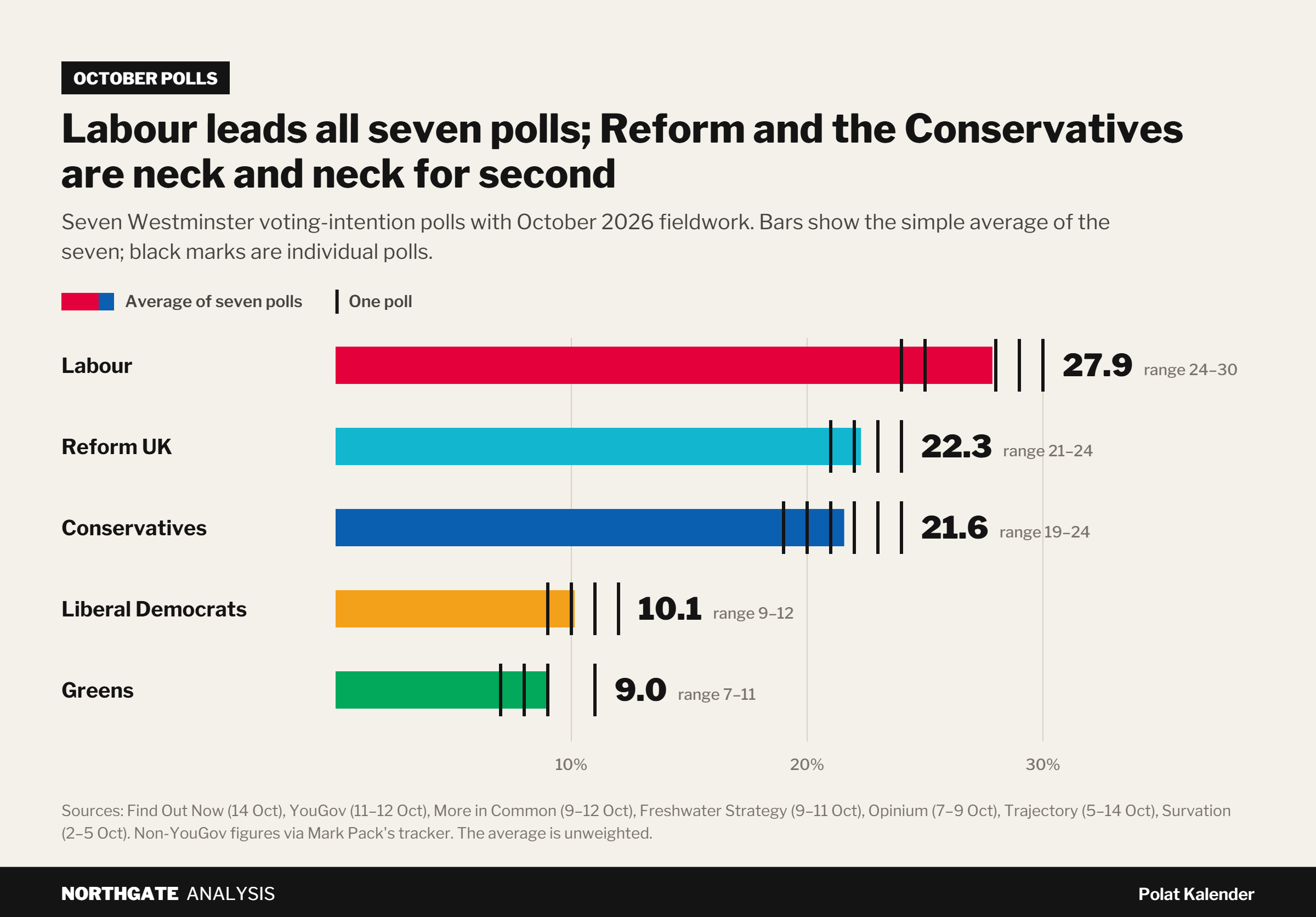
Figures other than YouGov's are taken from Mark Pack's polling tracker (accessed 16 October). House effects are large: YouGov consistently shows Labour lower than other pollsters do. No claim about the make-up of the bounce should rest on a single pollster. Almost all of these polls were also conducted before ITV broadcast its Reform investigation on 14–15 October.
The trend is clearer than the level. Survation had Labour on 19% in its final poll under Starmer; in October Labour leads all seven polls, on 24–30%. The Greens have fallen from a 12% peak to 7–11%, and Reform from its February peak of 32% to 21–24%.
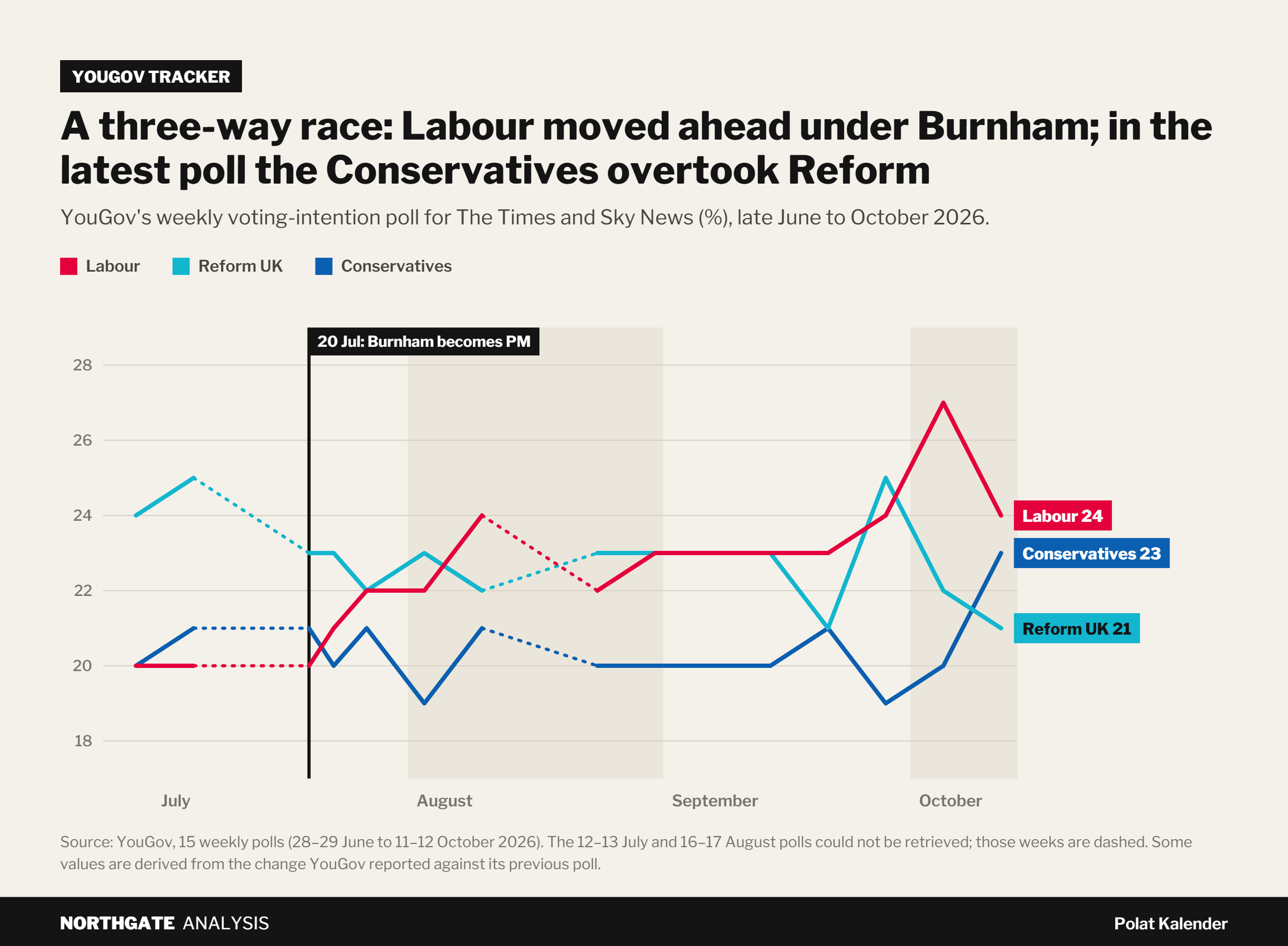
The genuinely new movement is on the right. The Conservatives, stuck at 18–21% since early 2025, rose to 19–24% in October. YouGov's poll of 11–12 October put them ahead of Reform for the first time since 2024 (YouGov; The Spectator), and More in Common has them three points ahead.
Where Labour's 2024 voters went, and where they are returning from
| 2024 Labour voters now backing… | March 2026 | September 2026 | Won back |
|---|---|---|---|
| Greens | 11% | 5% | 6 pts |
| Liberal Democrats | 6% | 5% | 1 pt |
| Reform UK | 11% | 7% | 4 pts |
Source: More in Common, Will Burnham rebuild Labour's coalition?, 28 September 2026. More in Common's own conclusion is that Labour now loses more of its 2024 voters to the right than to the left.
YouGov tells the same story from another angle:
- Since May, the share of 2024 Labour voters planning to back the party again has risen from 39% to 53%.
- The share defecting to the Greens or Liberal Democrats has fallen from 28% to 18%.
- Among 2024 Green voters, willingness to consider Labour rose from 24% to 39%; among 2024 Liberal Democrats, from 32% to 42%.
- In August, 2024 Green voters' net rating of the Labour leader moved 72 points in a single month, from −45 to +27.
Why Reform's voters are not coming back
Labour-to-Reform switchers are the hardest group to win back. In YouGov's Big Voter Study, published in mid-July just before Burnham took office, only 11% of them would consider Labour again, while 20% were weighing the Conservatives (YouGov). Professor Tim Bale told Al Jazeera that very little of Labour's recovery comes from Reform voters returning (Al Jazeera, 30 September).
A leader's bounce, not a party's
The recovery is attached to Burnham personally, not to Labour or the government.
- In late August YouGov put the government's net approval between −36 and −40, while Burnham's own rating stood at +13 (YouGov).
- Only 49% of those who think Burnham is doing a good job plan to vote Labour. The Labour brand sits at −17 and Burnham at +7 (More in Common). The gap is widest among the socially conservative working-class voters of the Red Wall, Labour's former heartlands in the North and Midlands: the brand is at −37 there, Burnham at 0. More in Common calls this segment "Rooted Patriots".
- Opinium finds Burnham rated positively on most personal attributes and Labour rated negatively on every one it measured.
There is a policy component too. Of the 16% of voters who made up their minds in the last three months, 38% chose Labour, and 41% of those cite its cost-of-living measures (More in Common). But on the evidence available, this is consolidation rather than conversion.
2. The encirclement
The strategy does not grow the anti-Reform vote; it gathers it. Makerfield showed the pattern in miniature, and national tactical-voting data shows it at scale.
Makerfield: consolidation, not persuasion
| Party | 2024 general election % | 18 June 2026 by-election % | Change (pts) |
|---|---|---|---|
| Labour | 45.2 | 54.8 | +9.6 |
| Reform UK | 31.8 | 34.5 | +2.7 |
| Restore Britain | — | 6.8 | new |
| Conservative | 10.9 | 2.2 | −8.7 |
| Liberal Democrat | 6.8 | 0.4 | −6.4 |
| Green | 4.4 | 0.7 | −3.7 |
Source: Wikipedia, citing the result declared by Wigan Council. Turnout rose from 52.5% to 58.8%.
Grouped into blocs, the picture is stark. Labour, the Liberal Democrats and the Greens took 56.4% in 2024 and 55.9% in 2026; Reform, the Conservatives and Restore took 42.7% and 43.5%. Burnham did not grow his bloc. He consolidated it, while the right split three ways.
Three caveats limit what Makerfield proves:
- Supply as well as demand. Former Green leader Caroline Lucas urged her party not to fight Burnham seriously (Left Foot Forward). The Greens then scaled back their campaign and shifted effort to the Greater Manchester mayoral by-election. That will not happen at a general election.
- Burnham kept the EU off the ballot. In a seat that voted an estimated 65% Leave, he promised not to reopen the Brexit debate.
- The polls missed by a wide margin. Final constituency polls had Burnham 5–12 points ahead; he won by 20.3.
The tactical arithmetic
YouGov's September tactical-voting study is the clearest national evidence of the encirclement (YouGov, 23 September). In a seat where only Labour or Reform can win, voters back Labour by 41% to 26%, up from 35% to 31% in February. YouGov describes this as bloc voting: Labour gains almost nothing from voters on the right, and Reform almost nothing from the left.
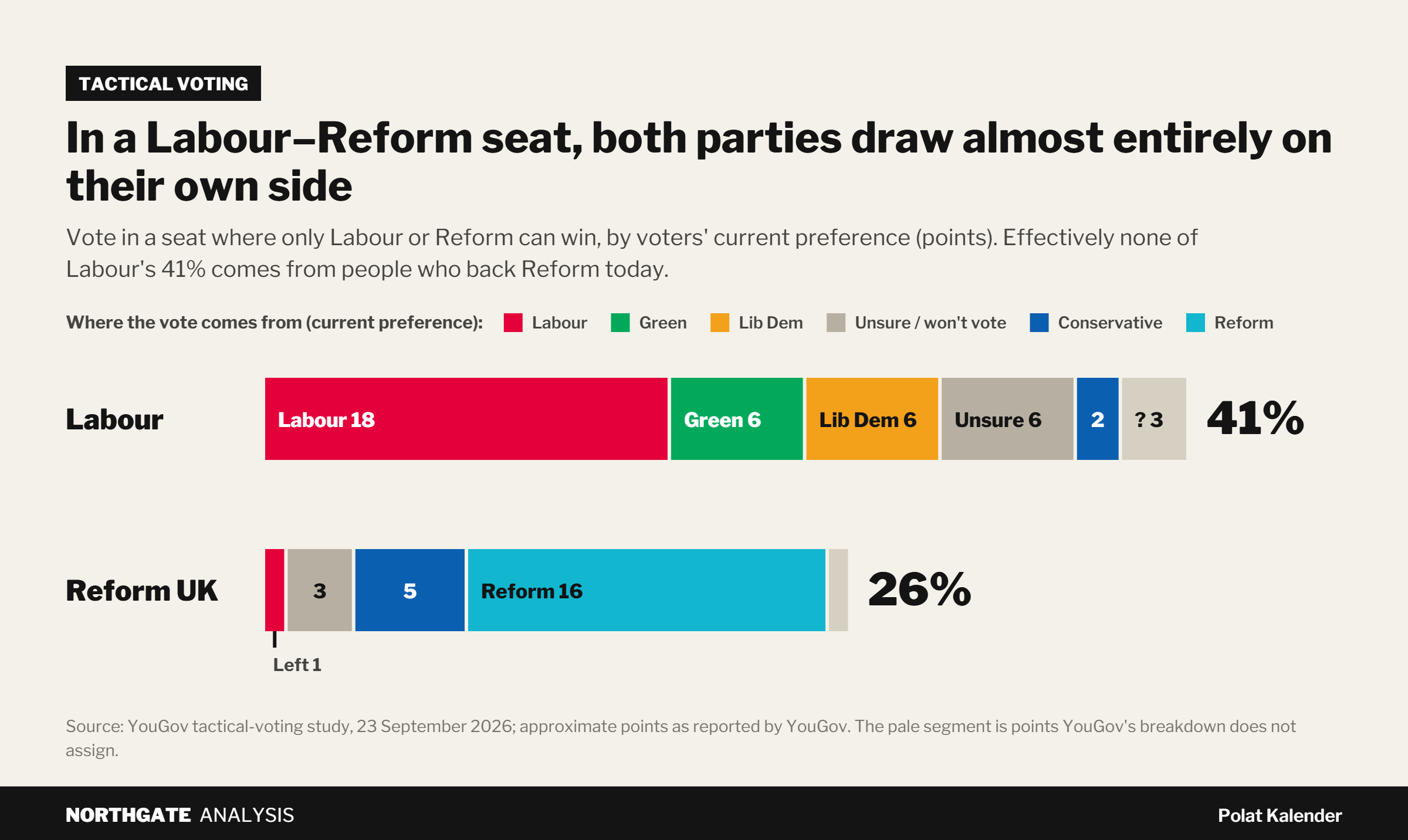
Only about two points of Labour's 41% come from current Conservative voters, and effectively none from current Reform voters. Only about one point of Reform's 26% comes from the left.
The reserve is large but largely untapped. Survation's MRP for 38 Degrees finds that just 3.5% of voters are voting tactically today. A further 18% say they would switch in a two-horse race, are in one, but have not yet done so (Survation, 25 September).
| Survation scenario | Reform seats | Labour seats |
|---|---|---|
| No additional tactical voting | 153 | 272 |
| Half of willing switchers move; campaign aimed only at progressives | ~90 | ~346 |
| Half of willing switchers move; neutral campaign | ~101 | ~295 |
| All willing switchers move | 62 (35–93) | 319 |
The arithmetic cuts both ways:
- A neutral tactical-voting campaign helps the right too. Telling every voter which two parties can win also tells Conservatives in Labour–Reform seats that Reform is their realistic option. Survation finds just over half of them prefer Reform to Labour; in YouGov's modelling, 37% would switch to Reform and 18% to Labour.
- The "coalition of the against" is not Labour's property. In a Conservative–Reform seat, 43–49% of current Labour and Liberal Democrat voters would back the Conservatives, who lead Reform there by 35% to 20% (YouGov). Anti-Reform sentiment rebuilds the Conservatives as readily as it rebuilds Labour.
The EU card
Burnham has declined to rule out a manifesto pledge to rejoin the EU or to hold a referendum, and he repeats that he wants Britain back in the EU in his lifetime (The Independent, via inkl). At conference, Labour described this year's EU summit as a floor rather than a ceiling (Labour Party, 29 September).
Public opinion favours rejoining in principle, but softly. In June YouGov found 55% in favour and 34% against; if rejoining meant losing Britain's old opt-outs, support fell to 35% and opposition rose to 43% (inkl). Only 21% of 2016 Leave voters back full membership (HotMinute, citing YouGov).
The Best for Britain MRP. The pro-EU campaign group Best for Britain commissioned YouGov to model four Labour positions on Europe (Best for Britain, 23 September):
| Labour's EU position | Projected Labour seats | Labour vote share |
|---|---|---|
| Current red lines | 136 | 26% |
| Customs union | 256 | — |
| Single market | 257 | — |
| Rejoin the EU | 321 | 37% |
Even in the membership scenario, Reform remains second on 191 seats (Best for Britain FAQ). The headline 321 should be read as a ceiling, for five reasons:
- Commissioning. Best for Britain is a registered pro-EU campaign group. This is advocacy research, not a neutral poll.
- Timing. YouGov surveyed 13,433 people between 27 May and 11 June 2026, before Burnham became Prime Minister. The model cannot separate an EU effect from the change of leader that followed. YouGov's own September MRP already gives Labour 241 seats without any EU pledge.
- Prompting. Best for Britain puts Labour's unprompted June vote share at 18%, but at 26% in the scenario describing current red lines. Simply describing a Labour policy added eight points, so scenario gains should be measured from 26%, not 18%.
- No campaign. Hypothetical questions cannot capture the counter-campaign that Reform and the Conservatives would run in Leave seats by reopening Brexit.
- Not raw YouGov output. Best for Britain layered its own adjustments, including tactical voting, on top of YouGov's central estimates.
Best for Britain's chief executive concedes the key point: voters who left Labour for Reform or the Conservatives are driven mainly by the cost of living, while it is the left bloc that wants EU membership. The EU card is a tool for consolidating the left, not for winning back Reform voters.
3. Reform's coalition ceiling
In none of September's models can any combination of right-wing parties reach a Commons majority. A Labour-led progressive majority is possible but not assured. Reform's problem is no longer finding votes but finding partners.
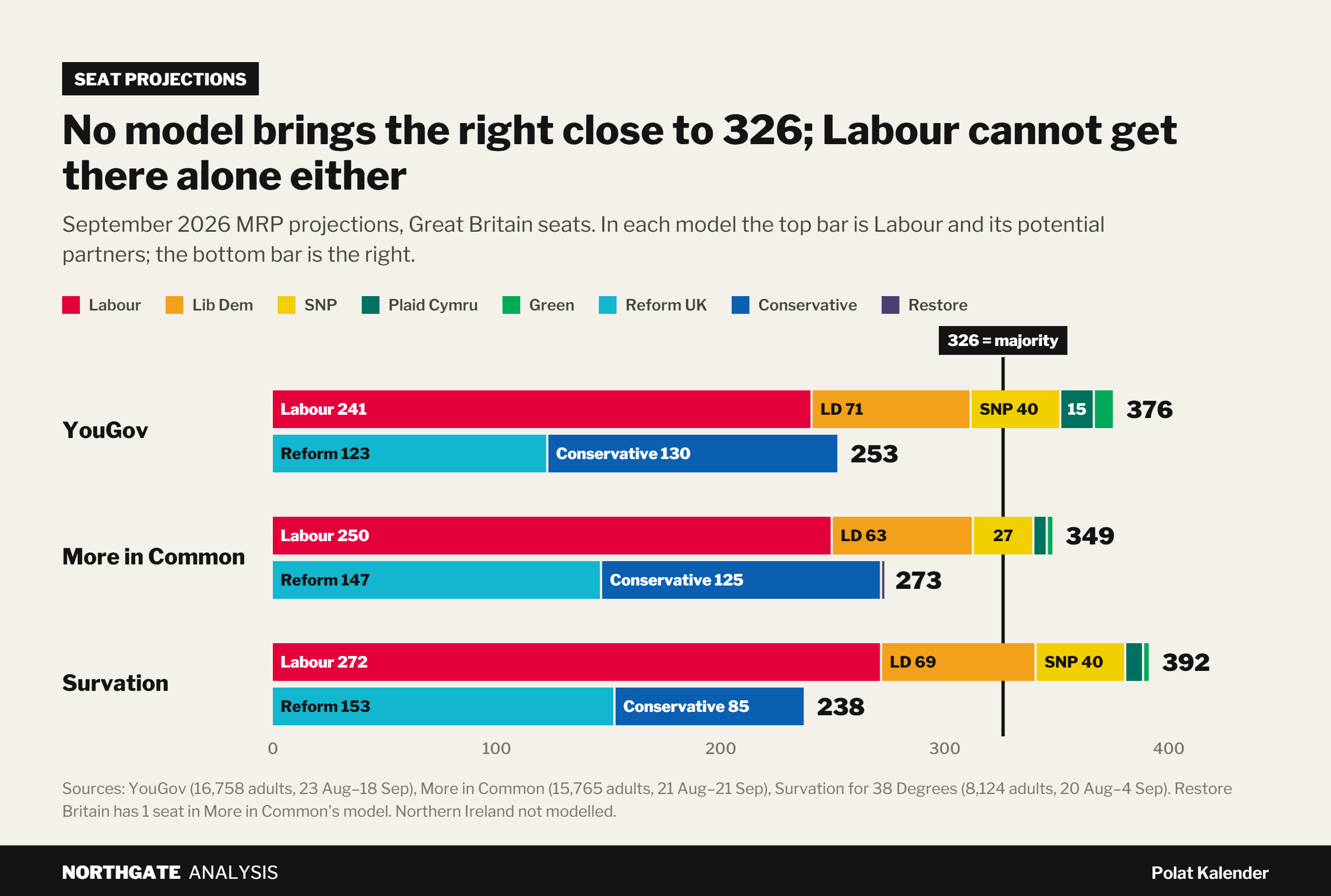
Sources: YouGov (16,758 adults, 23 Aug–18 Sep), More in Common (15,765 adults, 21 Aug–21 Sep), Survation for 38 Degrees (8,124 adults, 20 Aug–4 Sep), Electoral Calculus (4–11 Sep).
Electoral Calculus, which publishes only headline seat numbers, puts the Conservatives on 165, Reform on 84 and Restore on 1: a right-wing total of 250. On 288 seats, Labour falls short of a majority on its own there too.
Stonehaven's MRP, updated at the end of September, reaches the same conclusion: Labour 277, Reform 136 and the Conservatives 107, a right-wing total of 243 (Mark Pack).
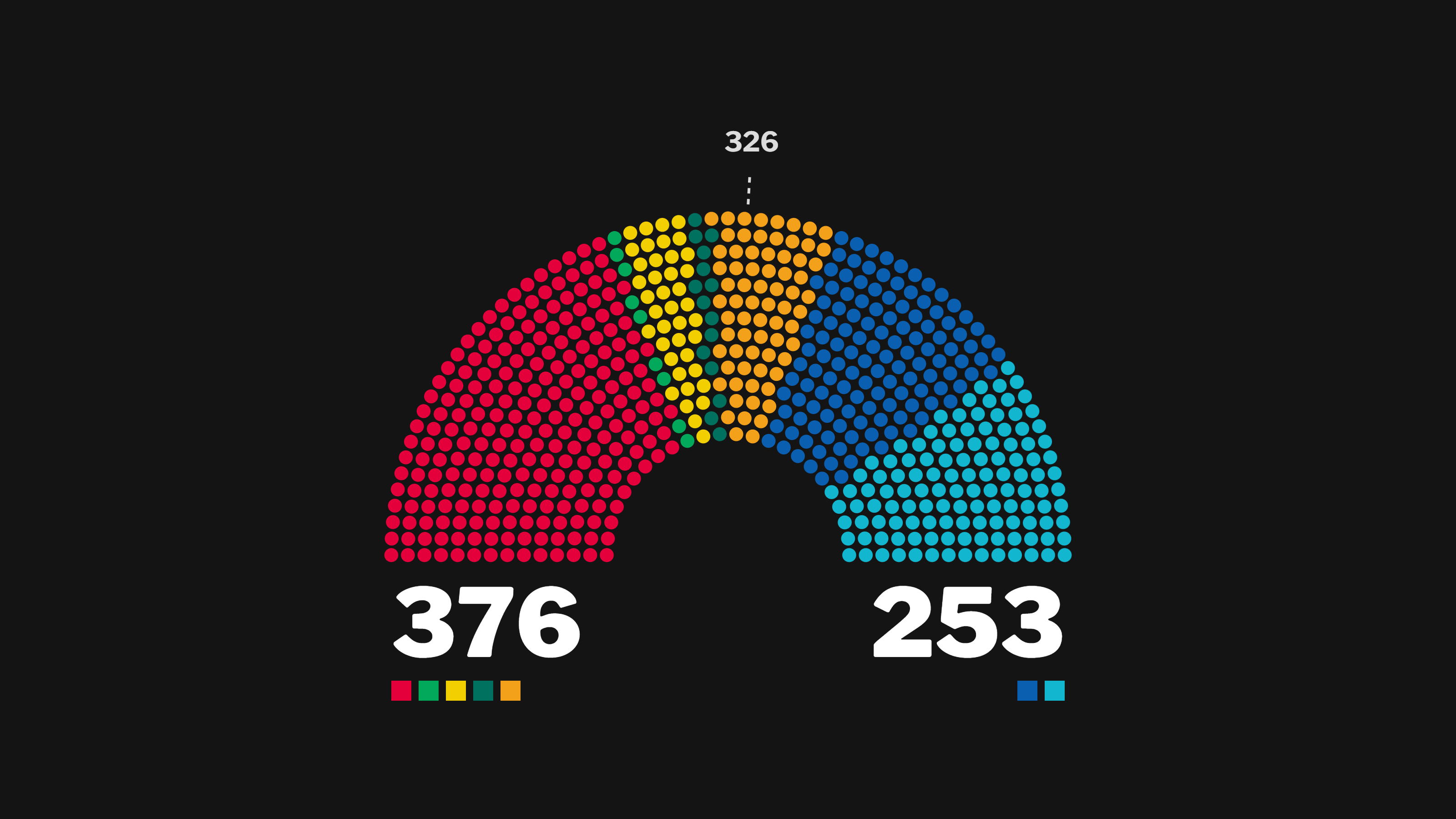
A majority requires 326 seats. Only Survation's model gives Labour and the Liberal Democrats one between them.
Why the right cannot combine
- The arithmetic. YouGov's head of elections, Patrick English, told The Times there is simply no path for Reform and the Conservatives to form a majority together (inkl).
- The leaders. Kemi Badenoch has ruled out a pact before or after an election (LBC, 6 August). She has said she would rather hold a fresh election than lead a Conservative–Reform government. Nigel Farage says he does not trust the Conservatives.
- Farage's own ceiling. In September 69% of Britons viewed Farage unfavourably, the highest figure YouGov's tracker has recorded (YouGov).
- The margins. About two-thirds of Reform's projected seats are won by under five points: 67% in YouGov's model and 69% in More in Common's.
Why Labour's majority is not safe either
- In YouGov's simulations, Labour and the Liberal Democrats reach a majority together in only 33% of runs. Adding the SNP raises that to 82%; all five progressive parties together reach one in 98%.
- More in Common finds that a two-point swing from Labour to Reform would make Reform the largest party, and a five-point swing would give it a majority. A three-point swing the other way would give Labour a majority on its own.
- The ceiling is not fixed. Best for Britain's June modelling, under Starmer, showed a parliament in which Reform and the Conservatives could form a coalition. That reversed within three months.
The price of partners
A Labour-led government would probably need at least one partner, and each would have a price.
- Liberal Democrats and Greens: electoral reform. Burnham has launched a National Commission on Electoral Reform, due to report before the next election (Labour Party). We judge it to be coalition currency as much as constitutional policy.
- Liberal Democrats: a door left open. Ed Davey has not ruled out a coalition with Labour, saying he does not deal in hypotheticals, but has dismissed a deal with the Conservatives (The Week).
- SNP: the constitution. John Swinney fought and won the May 2026 Holyrood election on a promise of independence. In 2019 Nicola Sturgeon made a second referendum the price of supporting a Labour government (Daily Mail, via PressReader, 9 November 2019). We assess it is likely (moderate confidence) that any SNP support for a Labour minority government would carry a constitutional price.
4. What could break the strategy
A formally united right is the least likely threat. The more serious risks are two: right-wing voters consolidating informally in marginal seats, and Reform's decline dissolving the glue that holds Labour's own coalition together.
Uniting the right: unlikely, and weaker than it looks
A Conservative–Reform alliance is worth far less than the sum of its parts. Lord Ashcroft's poll of 15 September finds the two parties' combined 41% falls to 28% on a joint ticket, with a ceiling of 33% (Lord Ashcroft Polls). That is 13 points short of the sum, worse than the 10-point shortfall Ashcroft found a year earlier.
An alliance would also push some centrist Conservatives towards Labour. Faced with a joint ticket, Labour's share rises by five points; only 8% of these new Labour voters come from the left, while 31% currently back the Conservatives. Labour's lead narrows only from seven points to five.
Both leaders reject a deal. Since Burnham's conference speech some Conservatives have pressed harder for one, partly for fear of a snap election in May 2027.
The first real test came at the Conservative conference in Birmingham on 4–7 October. In her speech on 7 October Badenoch again ruled out a pact, denounced the race-based nationalism of some in Reform and urged voters who had switched to Reform to "come home" (AP). We assess a formal national Conservative–Reform pact before the next election as unlikely (moderate confidence).
Defections: the names moved, the voters did not
| MP | Constituency | Joined Reform |
|---|---|---|
| Suella Braverman | Fareham and Waterlooville | 26 Jan 2026 |
| Andrew Rosindell | Romford | 18 Jan 2026 |
| Robert Jenrick | Newark | 15 Jan 2026 (sacked by Badenoch the same day) |
| Danny Kruger | East Wiltshire | 15 Sep 2025 |
Sources: Wikipedia, List of Reform UK MPs; Newham Recorder. Former MPs including Nadhim Zahawi (12 January 2026), Ben Bradley, Jonathan Gullis and Chris Green have also joined. ITV counted around 21 former Conservative MPs in Reform by January (ITV).
The defectors did not bring their voters with them. YouGov's September MRP projects the Braverman, Jenrick and Kruger seats as Conservative gains, and More in Common projects Jenrick and Kruger losing to the Conservatives. Both pollsters caution that estimates for individual seats like these are especially uncertain.
At grassroots level the traffic now runs the other way. As of 1 October, Mark Pack's list records 49 councillors elected for Reform in May 2026 who have since left or been suspended, plus 43 from earlier cohorts (Mark Pack). Some have gone to Restore Britain or the Conservatives, one to Labour, and many now sit as independents. Pack is a Liberal Democrat peer, but every entry links to local reporting.
Voter flows on the right
- The peak. In September 2025 Ipsos found 39% of 2024 Conservative voters intending to vote Reform (Ipsos).
- July. YouGov's Big Voter Study, published in July 2026, put the figure at 26%. Of those switchers, 73% would consider returning to the Conservatives and 31% are open to Restore Britain (YouGov).
- The Conservative ceiling is rising. The share willing to consider voting Conservative averaged 28% in September, up six points in a year (YouGov).
- October. The Conservatives are level with or ahead of Reform in three of seven polls. In More in Common's poll their three-point rise matches Reform's three-point fall; in YouGov's, Labour also lost three points.
- Restore Britain. It took 6.8% in Makerfield. National estimates range from 2–4% (Survation, YouGov, More in Common) to 7% (Electoral Calculus). More in Common finds 76 seats where Restore's vote share exceeds the margin by which Reform loses.
Reform's scandals are now Labour's problem too
Reform's troubles have built up over the summer:
- July–August. It emerged that the crypto billionaire Christopher Harborne had given Farage an undeclared personal gift of £5m. Farage resigned his seat to force a by-election in Clacton and won it back on 13 August, in a contest the other parties boycotted (Al Jazeera).
- September. An undercover Channel 4 investigation showed senior Reform figures discussing ways to take foreign money around the donation rules. Farage's long-time aide Dan Jukes and head of policy James Orr stepped down, and Labour and the Liberal Democrats reported the party to the police. Farage says no laws were broken.
- 14–15 October. ITV's Undercover: A Year in Reform filmed Reform councillors and candidates using racist language, some of it during the party's Makerfield campaign (ITV). Party officials are recorded saying they have to "defend the indefensible". At least three councillors have quit since the broadcast; Reform says it has opened investigations and that a handful of people may have slipped through vetting (ITV).
These scandals weaken Reform, but on this piece's logic they hand Labour no free gift. Much of the vote leaving Reform is going to the Conservatives, and the weaker Reform looks, the less fear holds Labour's voters together. Most October polls predate the ITV broadcast; its effect will show in late-October polling.
The informal threat: a right that consolidates without a pact
Voters do not need a pact to vote tactically. In seats where the Conservatives face a party of the left, 41–46% of current Reform voters would switch to the Conservatives (YouGov). In Labour–Reform seats, Conservative voters lean towards Reform. If both right-wing electorates learn which candidate can win locally, the encirclement loses much of its seat advantage.
The deeper threat: a strategy that undermines itself
Labour's coalition is held together more by opposition to Reform than by enthusiasm for Labour. More in Common finds that 63% of Labour supporters view Reform very unfavourably, while only 44% view Labour very favourably. In its breakdown of Labour's voter segments, stopping Reform winning locally also appears among the leading reasons for backing the party (30%) (More in Common).
More in Common draws the conclusion itself: if the Conservatives become a viable opposition again, voting Green stops looking risky to progressives. The race for second place is on a knife-edge. By More in Common's estimate, just one Reform voter in 96 would need to switch to make the Conservatives the official opposition again.
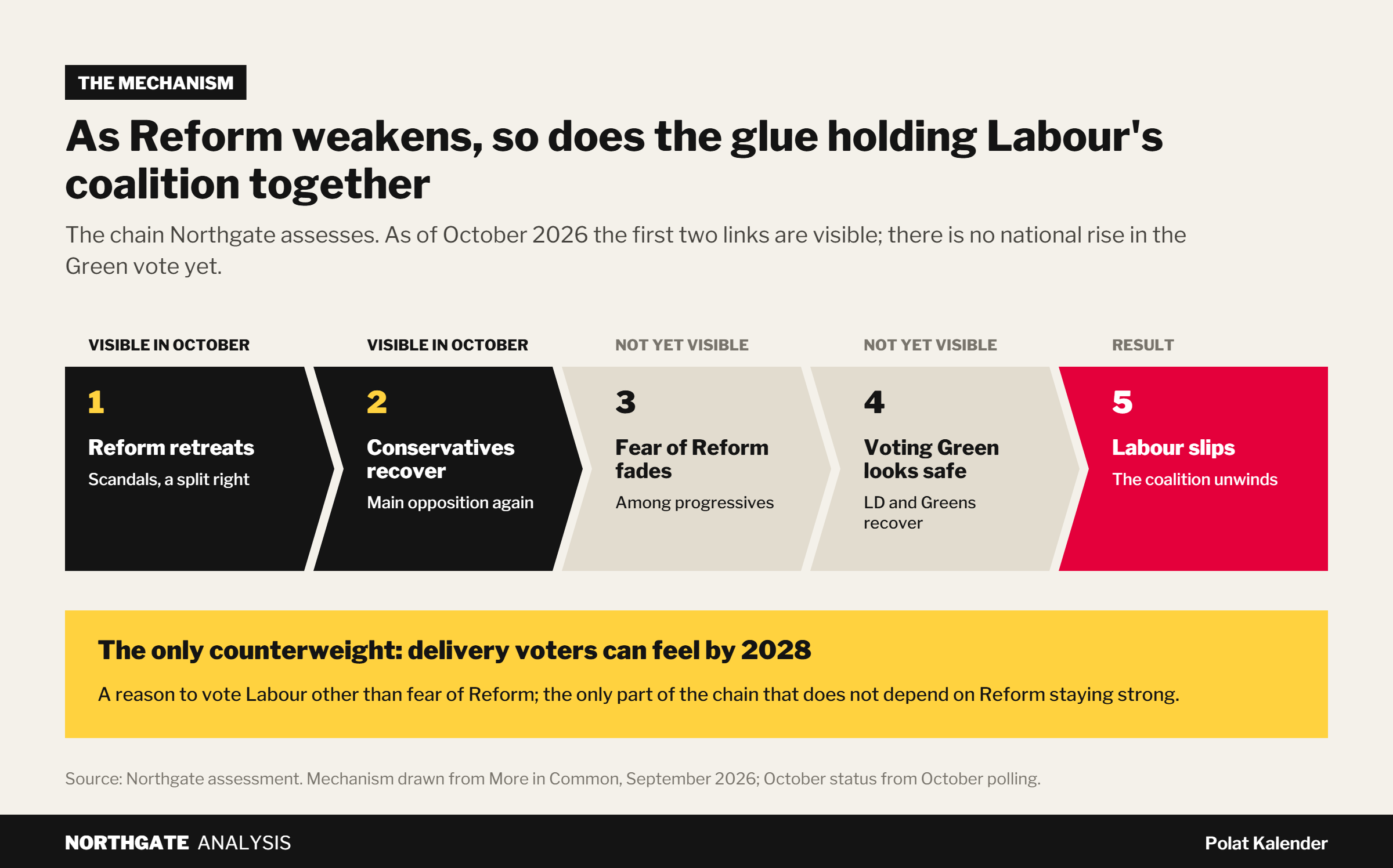
Felt delivery is the only part of Labour's position that does not depend on Reform staying strong.
The left flank is not secure either. The Greens still lead Labour among 18–24-year-olds by 30% to 25% and are second in 40 Labour-held seats, 21 of them in London. In February 2026 they won the Gorton and Denton by-election, in which Labour had blocked Burnham from standing (politics.co.uk).
Holborn: the result of the first test
The first direct test was the Holborn and St Pancras by-election on 8 October, in Starmer's old seat. The Green leader, Zack Polanski, faced Labour's Sagal Abdi-Wali, the leader of Camden Council.
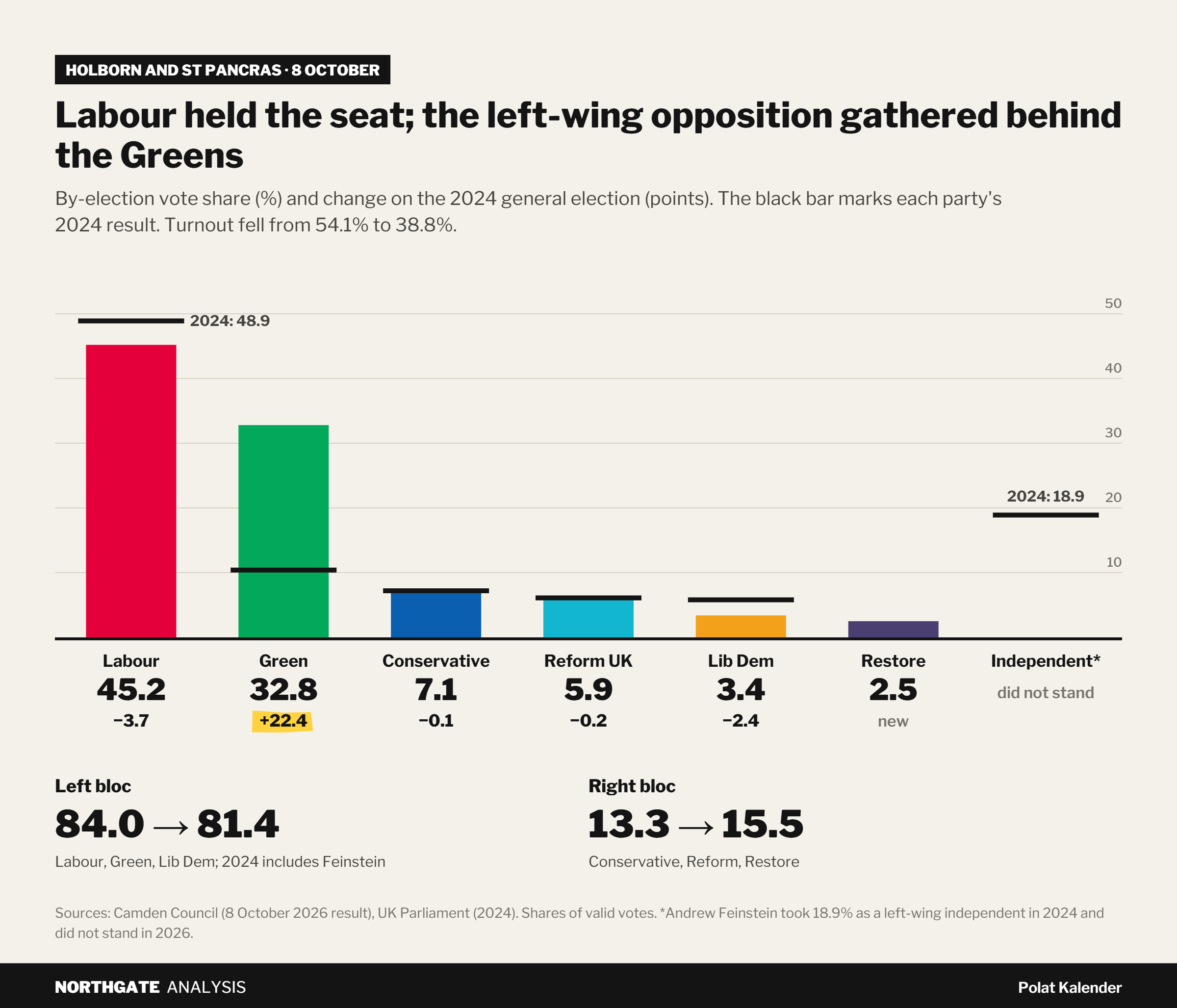
| Party | 2024 general election % | 8 October 2026 by-election % | Change (pts) |
|---|---|---|---|
| Labour | 48.9 | 45.2 | −3.7 |
| Green | 10.4 | 32.8 | +22.4 |
| Independent (Andrew Feinstein) | 18.9 | — | did not stand |
| Conservative | 7.2 | 7.1 | −0.1 |
| Reform UK | 6.1 | 5.9 | −0.2 |
| Liberal Democrat | 5.8 | 3.4 | −2.4 |
| Restore Britain | — | 2.5 | new |
Sources: votes from Camden Council; 2024 result from UK Parliament. Shares are calculated on valid votes. Labour won by 3,364 votes; turnout fell from 54.1% to 38.8%.
The result should be read three ways:
- Labour's vote largely held, even without a Reform threat. In a seat where Reform was not in contention, Labour lost only 3.7 points. That suggests Labour's support does not rest entirely on fear of Reform, and it is a warning for this piece's thesis.
- But the left alternative is consolidating into one party. The roughly 19% of the vote that went to the left-wing independent Andrew Feinstein in 2024 went largely to the Greens this time. The left bloc as a whole barely moved: Labour, the Greens and the Liberal Democrats took 81.4%, against 84% including Feinstein in 2024. Labour's rival on the left is no longer fragmented.
- The Greens fought in a difficult week. Days before polling, the party's conference passed a contentious motion defining Zionism as racism, and Polanski skipped the conference to campaign (ITV). The Green vote may therefore have been lower than it could have been.
Reform has fallen to third in two polls, but the national Green vote is so far flat (7–11%). Our judgement is therefore unchanged: if Reform falls to third for good, it is likely (moderate confidence) that Labour's lead over the Greens will erode. The first signs will appear in seats like Holborn, where Reform is not a contender.
5. The delivery gap
Labour's own timetable places most felt delivery after the point at which voters stop updating their judgement. Independent forecasts make matters worse: living standards rise in 2026-27 and fall over the parliament's final two years.
What conference promised, and when it bites
| Pledge | Takes effect | Felt by mid-2028? |
|---|---|---|
| National Care Service: free personal care for older people | "Next parliament", i.e. after the election | No |
| Triple lock: the earnings link goes; pensions rise by the higher of prices or 2.5% | April 2030 | No: neither the saving nor the cost |
| Public control in energy (GB Grid); bills brought into line with Europe | "Within ten years" | No |
| Water: lifting the bar on public ownership | Needs legislation | Unlikely to show in bills |
| Housing: council powers over bad landlords and empty homes | Needs legislation and funding | Limited |
| Avanti West Coast taken into public ownership | 7 March 2027 | Ownership, yes; service quality uncertain, since infrastructure causes about a third of delays, according to the DfT |
| Zero VAT on household electricity | 1 Oct 2026 – 31 Mar 2027 | Yes, but small and temporary: about £45 a year; gas still carries 5% VAT |
| £2 bus fare cap restored | 1 January to 31 December 2027 (outside London) | Yes, but only during 2027; unless extended, it lapses before the window closes |
| 20% business-rates cut for pubs, clubs and venues | April 2027 | Partly |
Sources: Labour Party; Nursing Times; Institute for Government; Survation for the government's estimate that the triple-lock change saves about £15bn a year by 2040; Express & Star; The British Eye; Grant Thornton.
The pattern is consistent. What voters can feel now is small and partly temporary, while the structural measures that justify the government's talk of a decisive break arrive after the election. The IFS's Jonathan Cribb warns that the triple-lock savings will be small at first and will not fund universal social care in the next parliament (Care Appointments, citing PA).
Where living standards stand
| Indicator | Latest | Context |
|---|---|---|
| Real regular pay (CPIH) | +0.6% a year (May–Jul 2026) | Private-sector nominal growth of 2.9%, joint lowest since October 2020; real growth is coming only from the public sector (ONS; Learning and Work Institute) |
| CPI inflation | 3.1% (August) | Up from 2.9% in July, driven partly by motor fuel (ONS) |
| Energy price cap | £1,723 a year from 1 October (+4%) | Includes the temporary electricity VAT cut (Ofgem) |
| NHS waiting list (England) | 7.37m pathways (August) | 65.2% within 18 weeks; 113,339 waiting more than a year; targets of 70% by March 2027 and 92% by March 2029 (NHS England) |
| Net additional homes since July 2024 | 437,900 (to 20 Sep 2026) | 29% of the 1.5m target with 44% of the time gone; Angela Rayner has called the chance of hitting it slim (BCIS; Full Fact) |
The Health Foundation's analysis of 8 October finds that, on current trends, the 92% target for 2029 will be missed: the wait within which 92% of patients start treatment would fall to about 20 weeks rather than 18 (Health Foundation).
The forecast is lopsided. The Resolution Foundation projects typical working-age incomes to rise by 0.9% (£300) in 2026-27, then fall by 0.5% (£150) over the parliament's final two years to 2028-29. The reason is the OBR's forecast of just 1.4% real wage growth over three years. A sustained Middle East energy shock would add about £500 to typical annual bills (Resolution Foundation, 4 March 2026).
The fiscal squeeze. KPMG estimates that the Iran war's effect on borrowing costs, together with weaker growth, has cut Chancellor John Healey's headroom from £23.6bn in the spring to about £12bn (inkl, reporting KPMG). Economists expect around £10bn of tax rises or spending cuts in the Budget on 28 October (Business Matters). Personal tax thresholds were already frozen until April 2031 in the November 2025 Budget.
Why the deadline is 2028, not 2029
Three pieces of evidence support the claim.
- Voters weight the end of the term. Healy and Lenz find that voters intend to judge a government's whole record but in practice substitute the election-year economy for it (American Journal of Political Science, 2014). Other work puts the "half-life" of the economic vote at about a year and a half (APSA preprint). The literature is not unanimous, and some studies find longer horizons. But for an election due by August 2029, the period that counts begins around early 2028.
- The fiscal calendar. Measures in the autumn 2028 Budget take effect in April 2029, only weeks before a summer election. The autumn 2027 Budget is in effect the last whose measures voters will live with for a full year before polling day.
- The electoral calendar. London and Greater Manchester elect their mayors on 4 May 2028. Bev Craig, who won the Greater Manchester by-election in July 2026, serves only until then (Institute for Government). Those contests will be read as a verdict on Burnham's home turf.
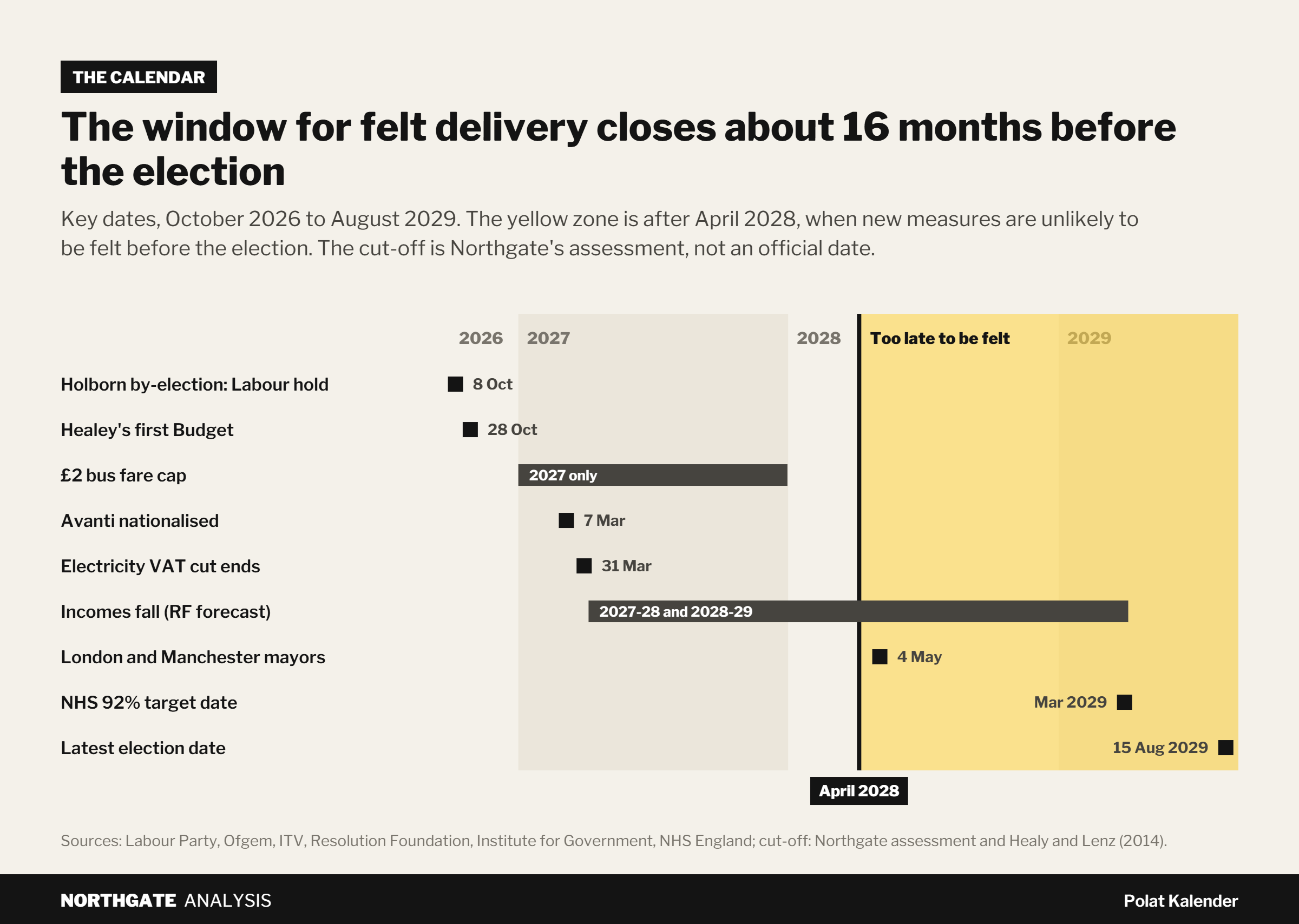
What voters can feel before the line is small or temporary; the structural pledges arrive after it.
The snap-election branch
Burnham has said publicly that the next election will be held in 2029 (inkl). But on 1 October the i Paper reported that sources close to No 10 still see May 2027 as a possible "sweet spot" (JOE, citing the i Paper). According to the report, the decision depends on how the Budget lands and whether the bounce lasts into the new year; party officials have been told to be ready, while many Labour MPs are opposed.
If Labour goes early, the delivery gap is not closed but bypassed. Labour would then fight almost entirely on Burnham's personal standing and the anti-Reform vote, which is precisely the dependency this piece describes.
6. Conclusion and recommendation
Encirclement buys Burnham time; it does not buy him 2029. Labour should turn the bounce into two or three targets that are measurable, felt by ordinary households and reachable by spring 2028.
The choice of targets follows the evidence. More in Common finds only two tests that unite every segment of Labour's coalition: the cost of living (60–63% across segments) and NHS waiting lists (39–47%). Immigration is the Red Wall segment's second test (47%) but divides the rest of the coalition (More in Common).
The proposal
| # | Target | By | Measured by |
|---|---|---|---|
| 1 | At least 80% of NHS patients in England treated within 18 weeks, the midpoint of the government's own path from 70% (March 2027) to 92% (March 2029), with waits of more than 52 weeks close to zero | March 2028 | NHS England monthly referral-to-treatment statistics |
| 2 | A typical household's energy bill lower in real terms in winter 2027-28 than in winter 2026-27, starting by making the electricity VAT cut permanent rather than letting it lapse in March 2027 | October 2027 | Ofgem price cap, deflated by CPI |
| 3 (optional) | One migration measure the government directly controls, with a stated level for 2028, published quarterly | Spring 2028 | Home Office quarterly statistics |
The third target is optional because it carries the most risk to the coalition. But the evidence suggests that risk is smaller than Labour fears. Migration is the top reason Labour-to-Reform switchers give for leaving (54%), yet only 12% of Labour-to-Green switchers cite dislike of Labour's migration policy (More in Common). It is the only lever that reaches beyond encirclement to Reform's Labour-origin voters.
Costs and trade-offs
- Money. A permanent electricity VAT cut costs revenue every year, in a Budget where economists expect around £10bn of tightening. The cost should be taken from the Treasury's own figures before publication.
- Opportunity cost. NHS capacity directed at planned-care waits competes with A&E and long-term care.
- Hostages to fortune. Starmer's December 2024 "milestones" became a list of targets he was on course to miss. Measurable targets create measurable failure.
The strongest objection
Targets invite the press to score failure, and the energy target depends on wholesale gas prices the government does not control. Answer: the alternative is worse. Without felt delivery, the question in 2029 becomes "has Reform fallen?" By then the answer may be yes, which would remove Labour's reason to exist for many of its voters. A small number of targets, reported monthly against a roadmap already published, limits that risk.
How we would know it is working
- NHS 18-week performance at or above 75% in the March 2027 data, and on track for 80% a year later.
- Labour's lead holding in polls taken while Reform is third, the scenario in which the anti-Reform glue is weakest.
- Labour holding the London and Greater Manchester mayoralties in May 2028.
The second test was run for the first time in early October. In the two polls that put Reform third, Labour still leads, but by just one point in YouGov's and four in More in Common's.
7. The case against this argument
The strongest objection is historical: British governments have won by defining the election against a feared opponent, even when voters did not feel better off.
The steelman
- Fear of the alternative can beat a bad economy. John Major won in 1992 in the middle of a recession, largely by putting Labour's tax plans at the centre of the campaign. Boris Johnson won in 2019 by framing the choice as Brexit against Jeremy Corbyn.
- First-past-the-post rewards a split opposition. In 1983 Margaret Thatcher won a majority of 144 on about 42% of the vote, because Labour and the SDP–Liberal Alliance divided the rest. A three-way split on the right could do the same for Labour.
- The bounce already contains delivery. Of recent Labour deciders, 41% cite its cost-of-living measures, and more than four in five Britons have heard of the £2 bus fare cap (More in Common).
- Labour is recovering in Reform's target seats, not only on the left. More in Common's September model has Labour gaining 143 seats since July, 101 of them from Reform, concentrated in the North West (+33), Wales (+16) and the North East (+14).
- Holborn. Even in a seat where Reform was not a contender, Labour largely held its vote (from 48.9% to 45.2%). That suggests Labour's support does not rest on fear of Reform alone.
- Voters may be less myopic than claimed. Some studies find longer retrospective horizons than Healy and Lenz do.
Why we judge it less likely
In 1992 and 2019 the feared opponent remained credible as a government until polling day. Reform is moving the other way: Farage's unfavourability stands at a record 69%, and two of September's four models put Reform third, behind the Conservatives; in October, polls by YouGov and More in Common did the same. The weaker Reform looks, the less work fear can do.
The Red Wall gains also come mainly from Reform's decline and the squeeze on the Greens, not from Reform voters switching to Labour. In YouGov's Labour–Reform scenario, effectively none of Labour's 41% comes from current Reform voters. Winning seats from Reform is not the same as winning votes from it. This is a divided opposition rather than a won argument, and divisions can close.
Holborn fits this picture. Labour held its vote, but the rest of the left consolidated behind a single rival, the Greens. Labour's left flank looks solid today; the real question is whether it holds once fear of Reform has gone.
Precedents: changing leader mid-term
| Years | Change | Result | Decisive factor |
|---|---|---|---|
| 2022 → 2024 | Johnson → Truss → Sunak | Lost | Collapse of credibility; Reform split the right |
| 2019 | May → Johnson | Won (majority of 80) | Snap election; a single message; the Brexit Party stood aside in Conservative seats |
| 2007 → 2010 | Blair → Brown | Lost (hung parliament) | Early bounce; no election called in October 2007; then the financial crisis |
| 1990 → 1992 | Thatcher → Major | Won (majority of 21) | Fear of the opposition despite recession |
| 1976 → 1979 | Wilson → Callaghan | Lost | Election delayed in autumn 1978; the Winter of Discontent followed |
| 1963 → 1964 | Macmillan → Douglas-Home | Lost narrowly (Labour majority of 4) | Closed the gap, but not enough |
| 1957 → 1959 | Eden → Macmillan | Won (majority of 100) | Felt prosperity |
Majorities: House of Commons Library.
The lesson is not that leadership changes fail. A new leader's bounce is common and short-lived. The winners combined it with felt improvement (1959) or with a feared, credible alternative (1992, 2019). Leaders who waited at the peak of the bounce for conditions to improve (1978, 2007) were punished when conditions turned.
8. What we expect next
Five dated, falsifiable expectations for the Northgate predictions ledger, each to be reviewed when it falls due.
| # | Expectation | By | Probability |
|---|---|---|---|
| 1 | NHS England's 18-week referral-to-treatment performance for March 2027 is below the 70% interim target | 31/05/2027 (data release) | Likely (moderate confidence) |
| 2 | No UK general election is held before 1 January 2028 | 01/01/2028 | Likely (low confidence) |
| 3 | No formal national electoral pact or coalition agreement between the Conservatives and Reform UK is announced before the next general election | Polling day | Likely (moderate confidence) |
| 4 | The National Care Service provides free personal care to no one before the next general election | Polling day (by August 2029) | Almost certain (high confidence) |
| 5 | The Budget on 28 October 2026 extends zero VAT on household electricity beyond 31 March 2027 | 28/10/2026 | Realistic possibility (low confidence) |
Reasoning in brief:
- (1) Performance was 65.2% in August 2026 and has stalled at around 65% since March. Reaching 70% requires roughly five points in seven months, and the Health Foundation projects that the 2029 target will be missed on current trends.
- (2) Burnham has publicly ruled out an early election, and many Labour MPs in marginal seats oppose one. But No 10 sources told the i Paper on 1 October that May 2027 remains possible, depending on the Budget; hence the low confidence.
- (3) Both leaders reject a pact; Badenoch repeated this in her conference speech on 7 October. Ashcroft's data show a joint ticket losing about a third of the two parties' combined vote.
- (4) Burnham has said the service will be built in the next parliament.
- (5) As of 1 October the government had made no commitment to an extension. The measure is popular but costs revenue in a tight Budget.
Sources
All accessed 2 October 2026.
Polling and modelling
- More in Common, Will Burnham rebuild Labour's coalition?, 28 September 2026
- More in Common, September 2026 MRP, 26 September 2026
- YouGov, MRP shows Labour would be the largest party in a hung parliament, 24 September 2026
- YouGov, What is the tactical voting landscape in September 2026?, 23 September 2026
- YouGov, How do Britons see Labour and Andy Burnham ahead of the party's conference?
- YouGov, political favourability ratings, August 2026 and September 2026
- YouGov, Why is government approval so low when Burnham's ratings are so high?
- YouGov, Big Voter Study 2026: the Conservatives' 2024 voters and how solid is Reform UK's rise?
- YouGov, How do Britons see the Conservatives ahead of the party's conference?
- Survation, Two months of Burnham, 25 September 2026
- Survation for 38 Degrees, Who's in second place? Estimating tactical voting, 25 September 2026
- Survation, Where will the public land on the triple lock changes and National Care Service plans?, 30 September 2026
- HuffPost UK, Labour soars to six-point poll lead, 30 September 2026
- Electoral Calculus, MRP poll, September 2026, 24 September 2026
- Opinium, Voting intention, 23 September 2026
- BMG Research, BMG and The i poll: voting intention ahead of the Budget, 28 September 2026
- Mark Pack, polling tracker and Reform councillors lost since May 2026, updated 1 October 2026
- Lord Ashcroft Polls, Can the right unite? The question revisited, 15 September 2026 (figures from the site's published excerpt; the page itself returned redirect errors)
- Ipsos, Reform UK leads by 12 points, September 2025
- inkl, Reform would win fewer seats than Labour and the Tories
The EU card
- Best for Britain, EU membership pledge key to a Labour-led government, 23 September 2026
- Best for Britain, FAQ: why EU membership might win Labour the next election
- The Independent, via inkl, Burnham declines to rule out manifesto bid to rejoin EU
- inkl, Does Britain want to rejoin the EU? What the polls say
- HotMinute, 55% of Brits now support rejoining the EU, citing YouGov
Events and parties
- Wikipedia, 2026 Makerfield by-election and 2026 Labour Party leadership crisis
- Al Jazeera, The Burnham bounce: why Labour's rising again, 30 September 2026
- Labour Party, Six things Andy Burnham announced at conference, 29 September 2026
- LBC, Badenoch rules out pact with Reform, 6 August 2026
- Wikipedia, List of Reform UK MPs; Newham Recorder; ITV, former Tories who have defected to Reform
- Left Foot Forward, Caroline Lucas calls for Greens not to campaign against Burnham, May 2026
- politics.co.uk, Andy Burnham wins Makerfield by-election
- The Week, Hung parliament: who could form a coalition?
- Daily Mail, via PressReader, Sturgeon's terms for supporting Labour, 9 November 2019
- JOE, citing the i Paper, Burnham 'leaving door open' for spring general election, 2 October 2026; inkl, Burnham rules out early general election
- PollCheck, Holborn and St Pancras by-election
- Institute for Government, Mayor of Greater Manchester
- House of Commons Library, UK Election Statistics: 1918–2023
Delivery and living standards
- Resolution Foundation, spring 2026 living standards analysis, 4 March 2026
- ONS, Average weekly earnings in Great Britain, September 2026; Learning and Work Institute, Labour market briefing, September 2026
- Ofgem, Energy price cap will rise 4% in October 2026; The British Eye, Healey urged to offer energy support as bills rise, 1 October 2026
- NHS England, RTT waiting times, July 2026 statistical press notice, 10 September 2026
- BCIS, Housebuilding and the 1.5m homes target; Full Fact, government tracker
- Institute for Government, Burnham should establish the National Care Service this parliament; Nursing Times
- Care Appointments, citing PA, Burnham sets out plan to reform triple lock, 30 September 2026
- Express & Star, Avanti West Coast services to be nationalised
- inkl, reporting KPMG, Chancellor's headroom to halve; Business Matters; Grant Thornton
- Healy, A. and Lenz, G. (2014), Substituting the End for the Whole, American Journal of Political Science 58(1); APSA preprint on the half-life of the economic vote
October update (accessed 16 October 2026)
- Camden Council, Holborn and St Pancras by-election 2026 results; UK Parliament, 2024 result
- ITV, Polanski vows to carry on as Greens leader after by-election defeat, 9 October 2026
- ITV Exposure, Inside Reform: councillors and candidates' extreme and racist views on camera, 14 October 2026; ITV, Reform officials admit they 'defend the indefensible', 15 October 2026
- Al Jazeera, Reform UK officials step down as new funding scandal hits, 4 September 2026
- AP, via the Atlanta Journal-Constitution, UK Conservative leader says the party is reviving and rules out a pact with Reform UK, 7 October 2026
- YouGov, Voting intention, 11–12 October 2026; The Spectator, Farage falls behind Badenoch in latest YouGov poll, 13 October 2026
- Mark Pack, polling tracker, updated 9 October 2026
- NHS England, RTT waiting times, August 2026 statistical press notice, 8 October 2026
- Health Foundation, Two years down, three to go: is progress on waiting times stalling?, 8 October 2026
- ONS, Consumer price inflation, UK: August 2026, 16 September 2026
- ITV, Burnham announces £2 bus fare cap from January, 22 July 2026